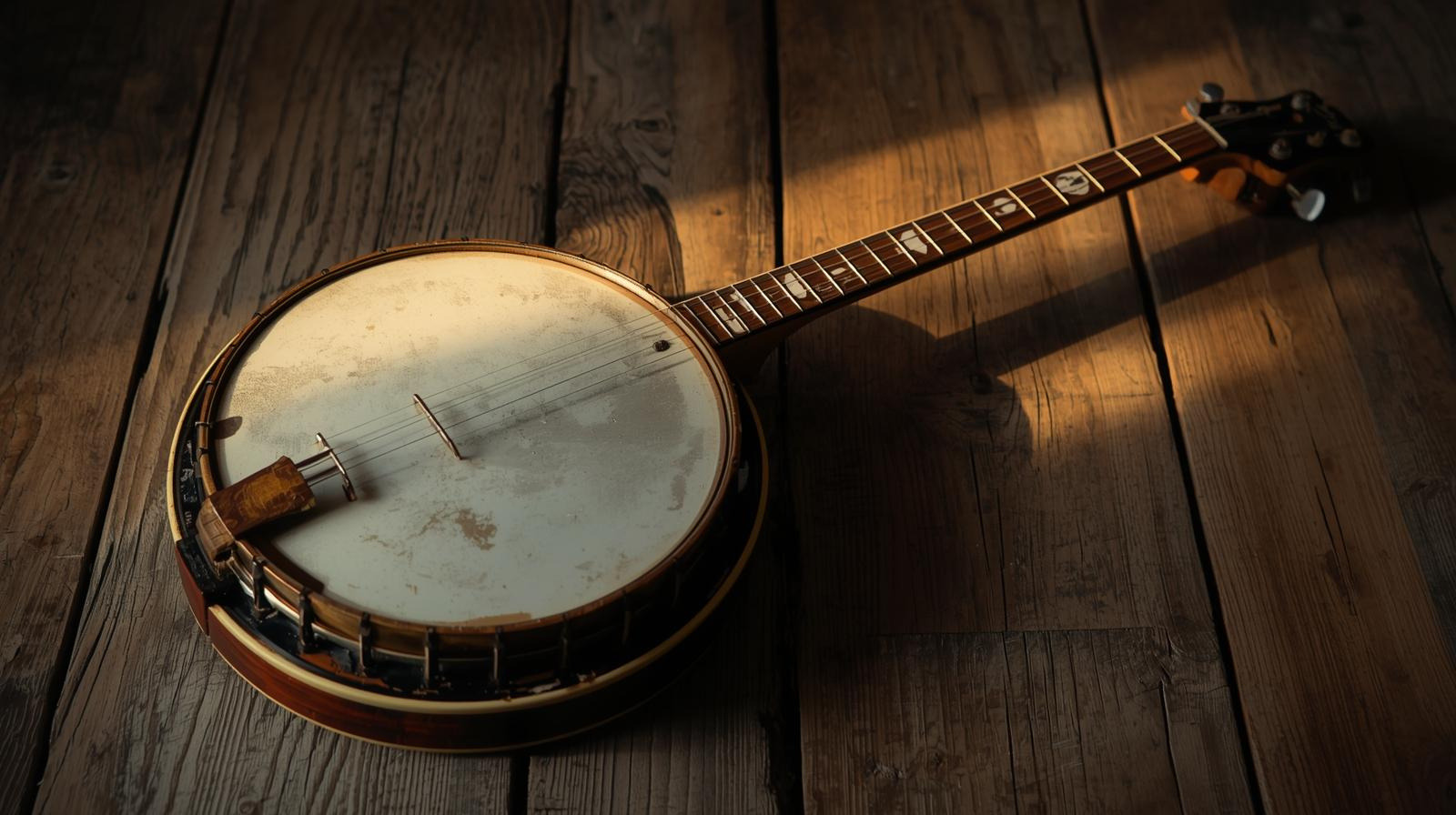
The banjo’s journey can not be told without the intertwining voices of Irish and Scottish settlers, enslaved and free Blacks, and the Appalachian communities that became the meeting ground of their traditions.
The Banjo: The Lego of Sound — Built by Many Hands
Imagine music as a vast Lego structure — every culture adding its own shapes, colors, and connectors to the foundation. Among the earliest pieces stands the kora/akonting of West Africa — a 21-string gourd instrument whose shimmering tones once carried history, praise, and lineage through generations. Each pluck was a Lego connector of memory — rhythm as architecture, storytelling as structure.
The First Blocks: Africa’s Memory Rebuilt in the New World
When Africans were forced across the Atlantic, they brought the blueprints of the kora musical structure in their minds and hearts. On plantations from the Caribbean to the Carolinas, they rebuilt it with what they had — gourds, animal hide, gut strings — re-creating the akonting and early gourd banjos. These instruments were not mere recreations; they were acts of remembrance; each note a bridge to home. Their polyrhythms, syncopation, and call-and-response created the rhythmic scaffolding of what would one day become American folk and roots music.
The Next Layer: The Celtic Strings Join In
Meanwhile, in the hills and hollers of Appalachia, Irish and Scottish immigrants arrived with their own musical Lego pieces — the fiddle, the Irish bodhrán drum, and centuries of ballads. Their reels and jigs — bright, driving, and filled with melodic ornamentation — brought harmonic threads that would soon snap perfectly into the rhythmic grooves of the African banjo. Both traditions shared an instinct for storytelling, improvisation, and communal performance — the fireside gathering, the dance circle, the jam session.
Appalachian music emerged in racially mixed, economically intertwined communities, not cultural silos. The banjo and fiddle met not as strangers, but as cousins: one carried rhythm, the other melody; one plucked, the other bowed; together, they created a sound that felt both ancient and new.
Rhythm found its melody, and melody found its heartbeat.
The Appalachian Builders: Shared Soil, Shared Sound
In the Appalachian Mountains, poor farmers, miners, Black laborers, and families of mixed ancestry all contributed their musical hands. Enslaved and free Blacks, Irish and Scots, and Indigenous neighbors shaped a collective storytelling tradition — music as survival, lament, celebration, and faith. From proximity came innovation: a shared musical grammar built from necessity and imagination. The banjo became a community’s connective piece — the instrument you could build, fix, and play anywhere. Its voice could cry, laugh, or dance. It clicked into the broader Lego structure of America’s soundscape, forming a base for blues, gospel, folk, and ultimately Bluegrass.
Takeaway: The hills kept the memory — and gave it harmony.
The Bluegrass Tower: A Masterpiece of Connection
By the early 20th century, Earl Scrugg’s banjo technique drew from older Black banjo styles as it was formalized in Bluegrass. The African rhythmic base, the Celtic melodic spine, and the Appalachian storytelling spirit all locked together. The banjo became its shining connector — bright, percussive, and central.
Each roll of the banjo still echoes the kora’s cascade, the akonting’s pulse, the fiddle’s reel, and the mountain storyteller’s drawl. Together they form a structure built not of stone or steel, but of shared humanity.
The legacy of the banjo, while evolving, is a contradiction verses it all-American origin. The banjo’s journey in revues and road shows is deeply tied to minstrelsy, starting as an African-rooted instrument played by enslaved people, then co-opted by white performers in blackface minstrel shows (1830s-1950s) that toured widely, popularizing the instrument but also embedding racist tropes, eventually leading to its adoption in Appalachian folk, jazz, and the 20th-century folk revival. However, new sounds and enlighten artists are reversing the cultural detour and returning the banjo to its proper canon of America music.
Citations and References
- Dubois, Laurent. The Banjo: America’s African Instrument. Harvard University Press, 2016.
→ Definitive modern work; directly supports your core thesis.
- Conway, Cecelia. African Banjo Echoes in Appalachia. University of Tennessee Press, 1995.
African Origins
- Charry, Eric. Mande Music: Traditional and Modern Music of the Maninka and Mandinka of Western Africa. University of Chicago Press.
- Winans, Robert B. “The Folk, the Stage, and the Five-String Banjo.” Journal of American Folklore.
Enslavement & Reconstruction
- Epstein, Dena J. Sinful Tunes and Spirituals. University of Illinois Press.
- Kubik, Gerhard. Africa and the Blues. University Press of Mississippi.
Appalachian & Cross-Cultural Exchange
- Bill C. Malone. Country Music, U.S.A.
- Whisnant, David. All That Is Native and Fine.
Minstrelsy & Cultural Appropriation
- Lott, Eric. Love and Theft: Blackface Minstrelsy and the American Working Class.
- Toll, Robert C. Blacking Up.
Contemporary Reclamation
- Giddens, Rhiannon & Flemons, Dom. Public scholarship, liner notes, lectures (Library of Congress, Smithsonian Folkways).
- Smithsonian National Museum of African American History & Culture — Banjo collections and essays.