Because we are born with a heart, we are born with rhythm. You can teach any person of nearly any age how to connect with that rhythm and the power of polyrhythms. Here are some lessons plans for specific age groups.
5-6 Year Olds
Perfect! Here’s your revised “Beat Explorers” lesson plan — same great structure, now with a fun, respectful, and imagination-driven theme. The framing is that students are musical explorers, discovering the world of rhythm through playful discovery.
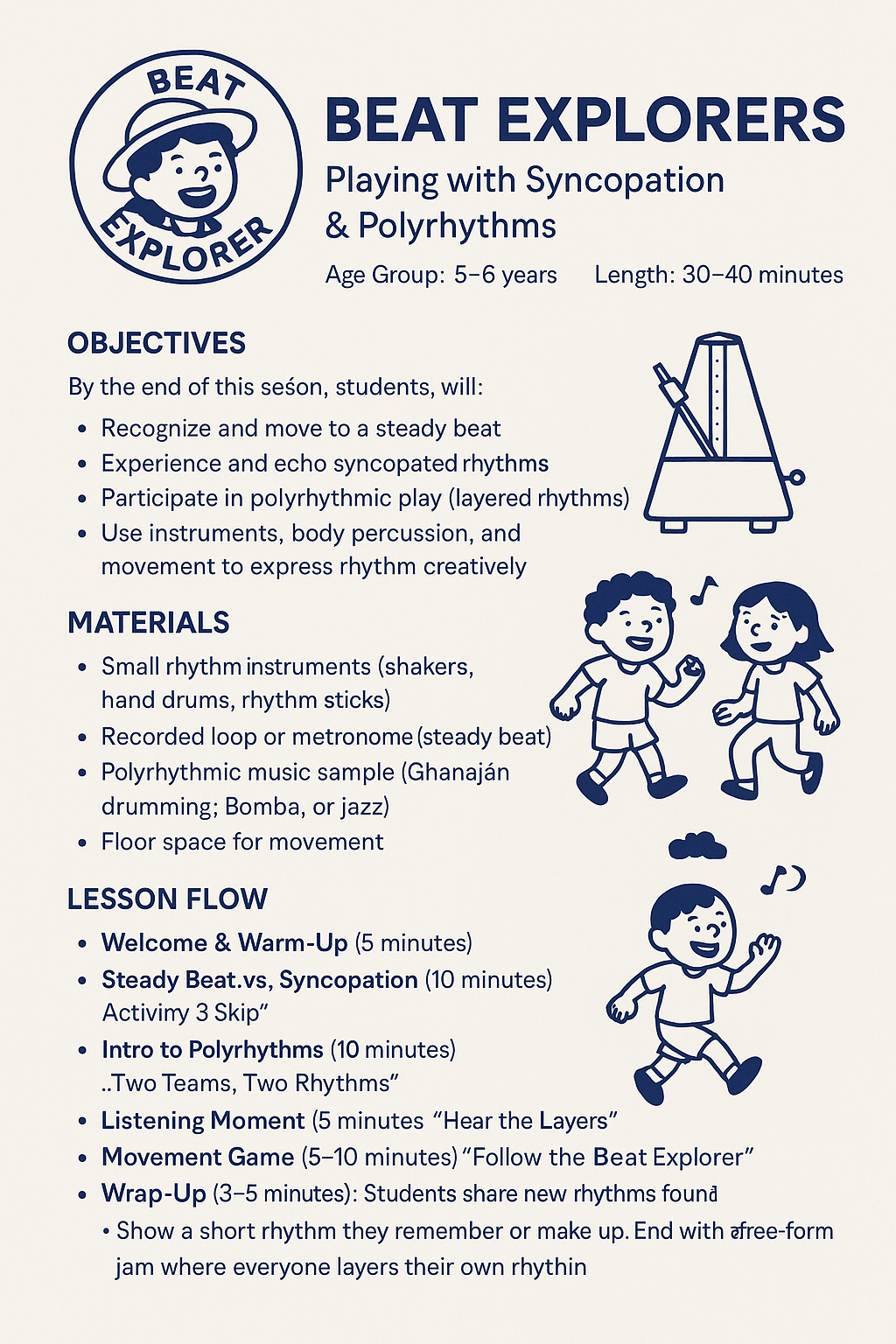
Lesson Plan: Beat Explorers — Playing with Syncopation & Polyrhythms
Age Group: 5–6 years Length: 30–40 minutes Theme: “Beat Explorers” — discovering surprising and layered rhythms through sound and movement
Objectives
By the end of this lesson, students will:
Recognize and move to a steady beat
Experience and echo syncopated rhythms
Participate in polyrhythmic play (layered rhythms)
Use instruments, body percussion, and movement to express rhythm creatively
Materials
Small rhythm instruments: shakers, hand drums, rhythm sticks
Recorded loop or metronome (steady beat)
Polyrhythmic music sample (e.g., Ghanaian drumming, Bomba, or jazz)
Floor space for movement
Visuals: “Beat Explorer” badges or a pretend map for fun
Lesson Flow
1. Welcome & Warm-Up (5 minutes) — “Let’s Get Exploring!”
Greet students with a rhythm: clap, stomp, snap — have them echo it.
Tell them: “Today, we’re Beat Explorers — we’re going to find rhythms that surprise us and rhythms that work together!”
2. Steady Beat vs. Syncopation (10 minutes) — “Surprise Beats!”
Activity: “March & Skip”
March to a steady beat: “Step… Step… Step…”
Then introduce a “surprise beat” (syncopation): hop off-beat or clap a pattern like “Clap — pause — Clap-Clap.”
Say: “These are syncopated rhythms — they surprise us by not landing where we expect!”
Repeat with rhythm sticks or hand claps.
3. Intro to Polyrhythms (10 minutes) — “Layer the Beats!”
Activity: “Two Teams, Two Rhythms”
Group A: Plays or claps a steady beat
Group B: Plays a syncopated or “skipping” rhythm
Practice separately, then combine both groups to make a polyrhythm
Ask: “Did you hear two rhythms at once? That’s called a polyrhythm!”
Optionally, rotate groups or create three layers with body percussion, instrument, and movement.
4. Listening Moment (5 minutes) — “Hear the Layers”
Play a short, engaging track of polyrhythmic music. Some good options:
Children’s Afro-Caribbean drum circles
Jazz with rhythmic layering
A short West African rhythm pattern (e.g., Ewe or Djembe-based)
Ask:
“Can you tap along to one rhythm?”
“Do you hear more than one pattern at the same time?”
5. Movement Game (5–10 minutes) — “Follow the Beat Explorer”
Teacher or student leader calls out rhythm patterns (clap, stomp, pat, hop).
Everyone mirrors the rhythm and movement.
Mix up syncopated patterns and steady ones.
Let students invent their own pattern and be the “Explorer Leader.”
6. Wrap-Up (3–5 minutes) — “Explorer Report”
Ask: “What new rhythms did we find today?”
Let each student show a short rhythm they remember or make up.
End with a free-form jam where everyone layers their own rhythm.
Give students a “Beat Explorer” sticker or stamp for completing their rhythm journey.
Extensions
Create a “rhythm map” where each new rhythm is a discovery
Record their final group polyrhythm and play it back next time
Use classroom objects to make everyday sounds rhythmic (tapping pencils, footsteps, etc.)